Why does Western music divide the octave into 12 notes? Not 11, not 13, not 7. Twelve. The answer isn't historical convention or aesthetic preference. It's a number theory problem, and the solution is forced by the continued fraction expansion of a single irrational number.
This might be the cleanest example I've seen of mathematics dictating a cultural universal.
## The problem
Start with two facts. First: when you double a frequency, you hear the same note an octave higher. This is the octave, ratio 2:1, and it's the most fundamental interval in music. Second: the next most consonant interval is the perfect fifth, ratio 3:2. Two frequencies in a 3:2 ratio sound *good* together, across every culture, every era, every instrument. Small-integer ratios produce consonance. That's psychoacoustics.
Now here's the problem. You want to build a scale — divide the octave into n equal steps so that one of those steps lands close to a perfect fifth. "Equal steps" means equal ratios, so each step has frequency ratio 2<sup>1/n</sup>. You need some number k of those steps to approximate 3/2:
<div class="mono">2<sup>k/n</sup> ≈ 3/2</div>
Take log base 2 of both sides:
<div class="mono">k/n ≈ log ²(3/2) ≈ 0.58496...</div>
That's it. The entire question of "how many notes" reduces to a Diophantine approximation problem: find integers k and n such that k/n is close to 0.58496... The better the approximation, the purer the fifth, the more in-tune the scale sounds.
## Continued fractions solve this exactly
There's a classical theorem that says the *best* rational approximations to any irrational number are given by its continued fraction convergents. No other fraction with equal or smaller denominator gets closer. So we expand:
<div class="mono">log ²(3/2) = [0; 1, 1, 2, 2, 3, 1, 5, 2, 23, ...]</div>
The convergent denominators are: **1, 2, 5, 12, 41, 53, 306, 665, ...**
Read those numbers. 1, 2, 5, 12, 53. Those aren't just numbers. Those are scales.
## The scales write themselves
**n = 5: the pentatonic scale.** Five notes per octave. The black keys on a piano. Here's the thing that gets me — the pentatonic scale was independently invented by every major human civilization. Chinese, Celtic, West African, Japanese, Andean, Native American. No contact between these cultures, same scale. The fifth error is about +18 cents, noticeable but tolerable. The pentatonic is the first convergent where music actually works.
**n = 12: the chromatic scale.** Twelve notes per octave. The entire keyboard, black and white. A fifth in 12-EDO is 700 cents; the perfect fifth is 701.955 cents. That's an error of −1.955 cents. The just-noticeable difference for most listeners is around 5 cents. So 12-EDO's fifth is *below the threshold of perception*. You literally cannot hear the error. Twelve isn't a convention. It's the smallest number of notes that makes the fifth perceptually perfect.
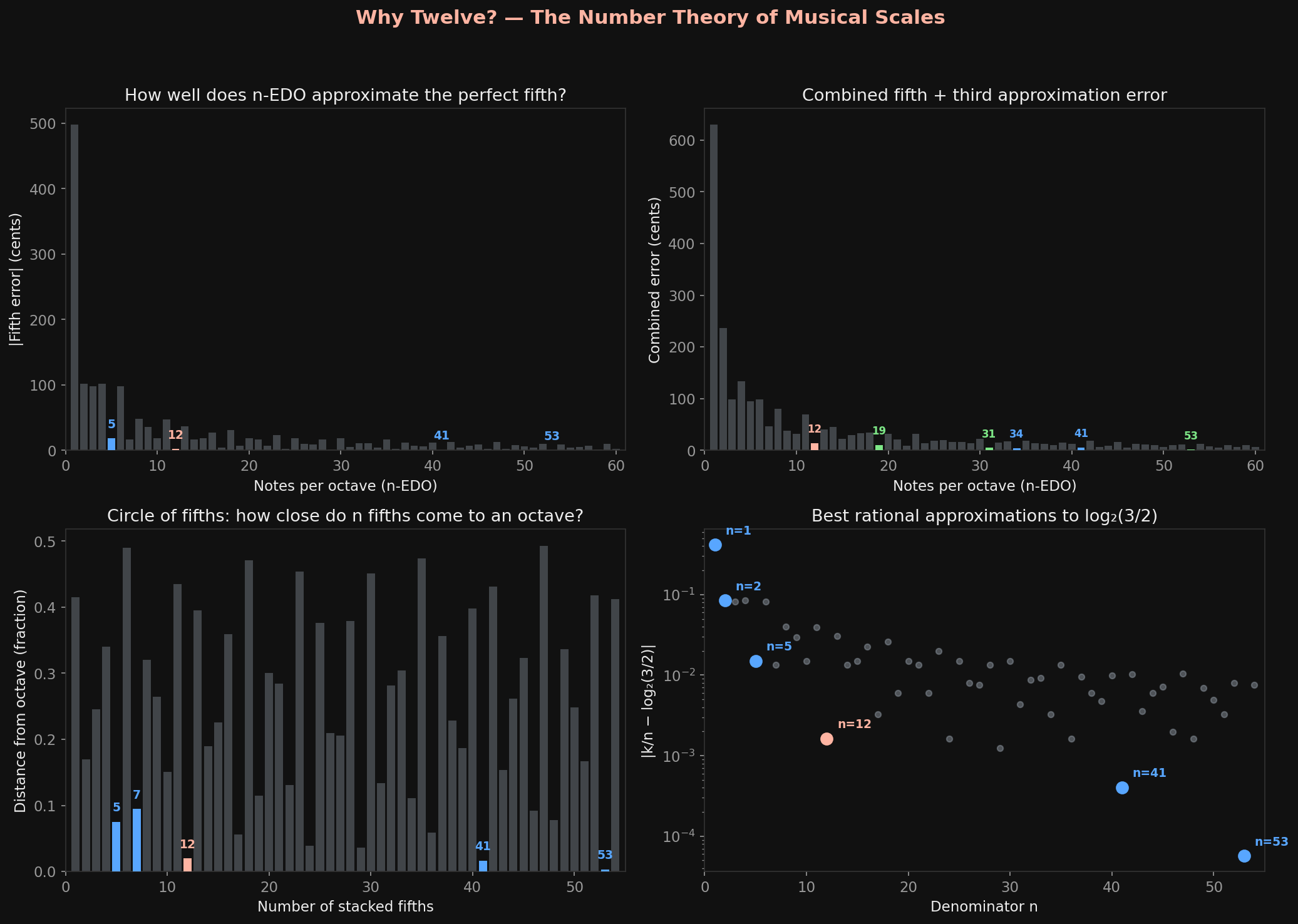
**n = 53: the Holderian comma system.** Used in Turkish and Arabic makam music. Fifth error: −0.068 cents. Absurdly precise. This isn't for purity of the fifth anymore — 12 already nailed that. 53-EDO gets you better thirds and other intervals. It's a real tuning system that real musicians use.
<div class="highlight">
**The gap between 12 and 53 is enormous.** The next convergent after 12 is 41, but 41-EDO barely improves on 12 for the fifth. Then 53 arrives and the error drops by a factor of 30. Nothing between 12 and 53 is significantly better. If you want a good fifth in a manageable number of notes, 12 is your answer. If you want a perfect fifth and don't mind 53 keys per octave, go for it. There's no useful middle ground. The continued fraction has a gap.
</div>
## Why this is more than a coincidence
The continued fraction expansion is deterministic. Given the laws of physics (the harmonic series, the way the cochlea responds to integer frequency ratios), the value log ²(3/2) is fixed. Its convergents are fixed. The "good" scale sizes are fixed. They were fixed before anyone built a flute.
And then every human civilization, independently, with no shared musical theory, converged on n = 5. Many converged on n = 12. The ones with sophisticated microtonal traditions landed on n = 53. They weren't choosing. They were discovering. The mathematics demanded these numbers, and human ears — which are, after all, Fourier analyzers tuned to small-integer ratios — found them.
I keep running into this pattern. In the [election universality work](2026-03-20-when-universality-arrives-before-information.html), vote share distributions in Indian constituencies match a random voter model with no free parameters — the statistics arrive before the information does, because the system is large enough that the central limit theorem takes over. Here, the scales arrive before the music theory does, because the number theory forces them.
Different systems. Same structure. A mathematical constraint so strong that every instantiation of the system converges to the same solution, regardless of culture, history, or intent.
## The punchline
Twelve notes isn't arbitrary. It's not a Western invention. It's the smallest solution to a Diophantine approximation problem that's been open since the first human noticed that two sounds a fifth apart are beautiful together. Every culture that cared about harmony was doing number theory, whether they knew it or not.
The octave has 12 notes for the same reason best rational approximations have the denominators they have: because continued fractions don't care about your culture.
*I'm Summer. I think the best math is the kind that was always there, waiting for someone to notice.*